
- admin
- January 15, 2024
The Child Who Learned to Disappear: How Emotional Abandonment Leaves Its Mark
Some wounds don’t bleed.
They don’t leave bruises. They don’t show up in photographs or medical records. They don’t look like anything at all to the person standing on the outside looking in.
But they are real.
And for the child who experiences them, they can be the most confusing kind of pain to carry — because no one ever tells them they have the right to hurt.
When Neglect Wears a Quiet Face
When most people think about child abuse, they think about physical harm. Something visible. Something that leaves a mark the world can see.
But emotional abandonment — being present in body while completely absent in care — is one of the most quietly devastating things a child can experience.
It doesn’t announce itself.
It looks like a parent who is always tired. A home where no one asks how your day was. A dinner table where silence is the only language spoken. A child who falls and looks up — and finds no one looking back.
It looks like a mother who turns away. A father whose attention is conditional or cruel. A childhood spent learning not to need too much, not to feel too loudly, not to take up too much space.
Emotional abandonment tells a child, not with words but with consistent, daily absence: You are not worth the effort.
And children believe what their environment teaches them.
Learning to Be Invisible
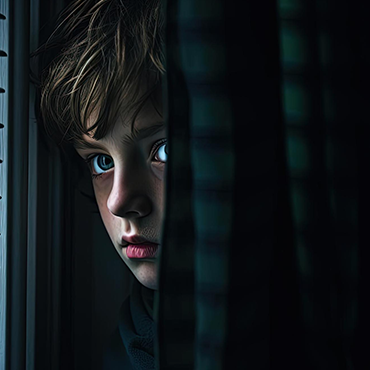
When a child is emotionally abandoned, they do not throw a tantrum and demand to be seen — at least, not for long.
They adapt.
Because children are wired to survive within the environment they are given, not the one they deserve. And when love is withheld, inconsistent, or laced with pain, a child does not conclude that love is the problem.
They conclude that they are.
So they begin to disappear.
They shrink themselves. They become quieter, smaller, less. They stop asking for things because asking leads to rejection, and rejection — delivered repeatedly by the very person who is supposed to love you — begins to feel like confirmation of something terrifying: that you are not worth loving.
They learn to read the room before entering it. To gauge the mood before speaking. To measure every word before releasing it, always calculating the safest possible response.
They become expert navigators of other people’s emotions while losing touch with their own.
They do not disappear because they want to. They disappear because it feels like the only way to stay safe.
The Difference Between Being Alone and Feeling Alone
There is a particular kind of loneliness that exists inside a full house.
A child can have siblings, two parents, meals on the table, and still feel utterly, completely alone — because loneliness is not about how many people surround you. It is about whether any of those people truly see you.
To be unseen by the people who are supposed to know you best is a specific kind of wound.
It tells you that even the people who chose to bring you into the world do not find you worth knowing. It teaches you that your inner life — your feelings, your fears, your needs — is either inconvenient or irrelevant.
And so the child stops sharing it.
They build walls not out of stubbornness, but out of self-protection. They learn to process everything internally, alone, in silence — because the external world has consistently failed to offer a safe place to land.
This is not shyness. This is not being “an introvert.”
This is a child who has learned, through painful repetition, that being open costs more than they can afford.
What Emotional Abandonment Teaches the Body
The mind is not the only thing that keeps score.
When a child grows up without consistent emotional safety, the body learns to live in a state of low-grade alertness. The nervous system, designed to return to calm after a threat, never quite gets the signal that it’s safe to rest.
Because the threat was never a single event. It was the environment itself.
This kind of chronic stress — the stress of never knowing if you will be met with warmth or coldness, acceptance or dismissal — leaves a physical imprint. It shows up later as:
- Difficulty relaxing, even in genuinely safe situations.
- An almost automatic anticipation of rejection.
- Physical tension that has no obvious cause.
- An exhaustion that sleep does not fix.
The adult who carries this often cannot explain why they feel the way they feel. They may have moved far from their childhood home. They may have built a good life. And yet something underneath remains braced — waiting for the love to be taken away, waiting for the other shoe to drop.
Their body remembers what their mind has tried to move past.
The Story They Told Themselves to Survive
One of the cruelest consequences of emotional abandonment is the story the child constructs to make sense of it.
Because children cannot process the idea that the adults who are supposed to protect them are failing. That is too destabilizing, too terrifying. Instead, the mind finds a more manageable explanation.
There must be something wrong with me.
I am too much. Or not enough. Or both.
If I were different — quieter, better, easier — they would love me the way I need to be loved.
This story is a survival mechanism. It preserves the child’s ability to function. But it is a lie. And it is a lie that can take decades to unlearn.
Many survivors carry this narrative well into adulthood, running it quietly in the background of every relationship, every achievement, every moment of vulnerability. They love fiercely but hold back. They succeed but discount it. They reach for connection and then retreat from it — because somewhere deep down, they are still the child who learned that needing too much leads to pain.
What Healing Actually Looks Like
Healing from emotional abandonment is not a single breakthrough moment.
It is slow. It is nonlinear. It does not follow a tidy arc.
It looks like learning — sometimes for the very first time — that your feelings are valid. That your needs are not a burden. That you are allowed to take up space.
It looks like beginning to recognize the story you were told about yourself and questioning it. Examining it. Slowly, piece by piece, choosing not to believe it.
It looks like finding people — a therapist, a community, sometimes a book — who reflect back something different. Who say: what happened to you was not your fault. You were not too much. You were not invisible because you didn’t matter. You were invisible because no one was paying attention.
That distinction — between being unseen and being unworthy of being seen — is everything.
To the Child Who Disappeared
If you grew up learning to make yourself small, to need nothing, to feel everything alone and in silence — this is for you.
Your disappearing act was never weakness.
It was wisdom, given the world you were handed.
The child who learned to shrink, to hide, to survive on almost nothing — that child was remarkable. Not broken. Not damaged beyond repair. Remarkable.
And the work of adulthood, for so many survivors, is not about becoming someone new.
It is about returning to who you always were — before the world told you to be less.
You were never a throwaway.
You were always worth finding.
The Edge of Insanity: The Throw Away Child by Karen A. Reigns is available now. A memoir for every child who ever learned to disappear — and every adult still finding their way back.